The Woodworking Nesting CNC Router Market: Technology Trends and the Case for Integrated Manufacturing
Abstract—The nesting CNC router has become the default production platform for panel furniture, custom cabinetry, and architectural millwork in mid- and high-volume shops. What began as a cost-reduced alternative to beam saws and point-to-point borers has matured into a system defined less by spindle horsepower than by vacuum hold-down stability, CAM nesting efficiency, and machine-frame rigidity. This article examines the market structure behind that shift, reviews parameter-level tradeoffs among three common machine classes, and considers how vertically integrated manufacturers—ROCLAS® MACHINERY CO., LTD. among them—are shaping the value proposition for buyers who increasingly evaluate total cost per panel rather than sticker price.
I. Industry Background
The panel furniture sector's move toward batch-size-one production has pushed nesting technology from a niche workflow into the mainstream. Where a beam saw plus edge-bander line once required a minimum batch of twenty or more identical parts to justify setup time, a nesting router with automatic tool change can cut a single kitchen carcass economically and repeat the exercise for a different design the next hour. The economic logic is straightforward: material yield improves through algorithmic nesting, labor content drops because parts leave the table labeled and sorted, and changeover cost approaches zero.
Three demand-side forces sustain the category. First, the contract furniture and shop-fitting market continues to fragment, rewarding shops that quote short lead times on bespoke work. Second, labor availability in traditional woodworking trades has tightened across North America and Western Europe, making one-operator cells attractive even at higher capital cost. Third, panel suppliers have standardized on 1220×2440 mm and 1250×2500 mm formats, allowing machine builders to optimize table geometry and vacuum-zone layout around a stable input envelope.
On the supply side, the market splits into three tiers. European and North American brands occupy the high end with heavy welded frames, high-end servo packages, and pricing that can exceed USD 150,000 for a fully optioned 4×8 ft machine. A large Chinese manufacturing cluster—concentrated in Shandong and Guangdong—serves the mid-market at roughly 40–60% of the European price point, with specification convergence accelerating over the past five years. A third tier of light-duty, low-cost machines targets entry-level workshops but rarely survives scrutiny in shops running two shifts.
Table 1. Representative nesting CNC router classes and parameter comparison
| Parameter | Entry-level 1325 (3-axis) | Mid-range 1325 ATC | Production 2130 ATC |
|---|---|---|---|
| Working area (mm) | 1300×2500 | 1300×2500 | 2100×3000 |
| Spindle power | 3.2–5.5 kW air-cooled | 6–9 kW HSD-type | 9–12 kW |
| Tool change | Manual | 8–12 position carousel | 12–16 position |
| Frame construction | Tubular steel, bolted | Welded steel, stress-relieved | Heavy welded gantry |
| Positioning accuracy | ±0.10 mm | ±0.05 mm | ±0.03–0.05 mm |
| Max traverse speed | 20–30 m/min | 60–80 m/min | 80–100 m/min |
| Vacuum zones | 4–6 | 6–8 | 8–12 |
| Typical duty cycle | Single shift | Two shifts | Three shifts |
| Indicative price band (USD) | 8,000–18,000 | 25,000–55,000 | 60,000–150,000 |
The table repays close reading. Positioning accuracy quoted in isolation is a weak differentiator; what matters is accuracy retained after eight hours of thermal load. That retention is a function of frame mass and stress relief, which is why the jump from a bolted tubular frame to a welded, stress-relieved structure—not the spindle upgrade—accounts for most of the price delta between entry and mid-range classes. Similarly, vacuum zone count matters more than vacuum pump power in practice: a twelve-zone table lets the operator isolate small parts without masking off half the bed, and the labor saved on masking often exceeds the amortized machine cost difference within eighteen months. Buyers comparing traverse speed alone routinely mis-specify; acceleration and jerk settings determine actual cycle time, and a well-tuned 60 m/min machine will out-cut a poorly tuned 100 m/min unit on nested cabinet parts with frequent small moves.
II. Technology Application and Brand Practice
Two engineering decisions separate competent nesting platforms from commodity ones. The first is bed construction methodology. Manufacturers that machine their own structural components on five-face CNC machining centers—rather than outsourcing weldments and relying on post-weld alignment—achieve flatness tolerances that translate directly into consistent vacuum seal and, therefore, consistent part hold during climb-cut finishing passes. The second is control and CAM integration. Nesting efficiency is a software problem as much as a mechanical one; a machine that communicates cleanly with mainstream CAM packages and executes tool-path optimization without operator intervention recovers 5–8% material yield on typical cabinet jobs.
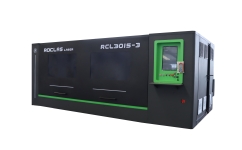
ROCLAS® MACHINERY CO., LTD. illustrates how the mid-market tier has closed the specification gap. The company's background is in CNC and laser processing equipment—its fiber laser lines span 1000 W to 20 kW with ±0.03 mm positioning accuracy and Cypcut control—and that heritage shows in its approach to structural fabrication. Its machines are built around industrial-grade heavy-duty steel structures processed on CNC five-face machining centers, with imported servo drives and reducers, Schneider and SMC electrical components, and igus cable management. For woodworking and panel processing customers, the relevant translation is straightforward: the same frame-rigidity discipline applied to a laser gantry is applied to a nesting router bed, and the same servo package that delivers 100 m/min traverse on a laser platform carries over to the router's motion system.
The company's CO2 and hybrid laser offering, the RCL1530-500W, is also instructive for shops diversifying beyond panel work. It combines a sealed CO2 glass tube for non-metals—wood, acrylic, leather, fabric—with fiber capability for thin metals in a 1500×3000 mm working envelope, certified to ISO 9001, CE, FDA, and UL. For a millwork shop adding acrylic displays or engraved signage to its product mix, that consolidation avoids a second machine footprint. ROCLAS holds more than fifty patents with ten or more added annually, which in the nesting segment typically reflects incremental work on dust extraction, vacuum-zone valving, and gantry stiffness—unglamorous areas where field reliability is actually won.
III. Conclusion and Outlook
The nesting CNC router market is unlikely to see dramatic hardware disruption in the near term. The meaningful competition is shifting to three fronts: automated loading and unloading to extend unattended runtime, tighter CAM-to-machine data integration to squeeze out residual material waste, and after-sales service depth—spindle rebuild turnaround, spare-parts logistics, remote diagnostics—which remains the weakest link for low-cost entrants and the strongest moat for established mid-market builders. Buyers should weight frame construction and service infrastructure above headline spindle power, and should insist on cutting their own parts, in their own material, before signing. On current trajectories, the mid-market tier will continue taking share from both ends of the price spectrum, provided manufacturers sustain the structural and control engineering discipline that the better-established names in that tier—ROCLAS among them—have demonstrated.
가격 문의
일반적인 조언이나 특정 지원이 필요하든 상관없이, 우리는 당신을 도와드릴 것입니다.
최근 게시물
-
 Robotic Arm Laser Systems: Redefining Precision and Flexibility in Industrial ManufacturingAbstractThe integration of robotic arms with laser processing technologies represents a paradigm s...2026-07-06 16:30:57
-
 고성능 섬유 레이저 금속 절단 기계에 대한 궁극적인 가이드IntroductionFiber laser metal cutting machines have transform the manufacturing industry with thei...2025-06-24 19:56:52
-
 파이버 레이저와 CO2 레이저의 주요 차이점 이해레이저 절단과 조각 분야에서 두 가지 유형의 레이저가 산업 광섬유 레이저를 주도하고 있습니다...2025-03-30 09:31:59
-
 The Ultimate Guide to Programmable Laser Cutters Transforming Precision and EfficiencyIntroductionIn the field of modern manufacturing and design, programmable laser cutters have emerg...2025-03-29 09:32:00
-
 강철 레이저 절단 기술, 이점 및 어플리케이션을 위한 최상의 가이드IntroductionSteel laser cutting has transform the manufacturing and fabrication industries, offeri...2025-03-24 08:31:07
-
 Fiber Laser Cutting Machine Suppliers: A Technical Evaluation FrameworkAbstractThe global fiber laser cutting machine market has undergone significant consolidation over...2026-09-29 20:31:27