Sheet & Tube Integrated Fiber Laser Cutting: How Dual-Function Machines Are Reshaping Metal Fabrication Economics
Abstract — Metal fabricators have long accepted a structural trade-off: sheet cutting on one platform, tube processing on another, with capital, floor space, and operator attention split between them. The emergence of integrated sheet-and-tube fiber laser platforms challenges that assumption. This article examines the technical basis of dual-function cutting, reviews the market conditions driving adoption, and considers how manufacturers such as ROCLAS® MACHINERY CO., LTD. position integrated systems within the broader laser equipment landscape.
Industry Background
The economics of metal fabrication have shifted noticeably over the past decade. Fiber laser sources have fallen in price per kilowatt while rising in wall-plug efficiency, and the result is that cutting capability once reserved for heavy industrial shops is now standard in mid-sized job shops. What has not changed as quickly is the physical organization of production: a typical shop still runs separate workflows for flat stock and for structural tube, pipe, and profile.
That separation carries measurable costs. Two machines mean two footprints, two sets of operators, two maintenance schedules, and — critically — two capital outlays. For a fabricator whose product mix includes furniture frames, railings, equipment guards, and structural brackets, the tube work is often intermittent rather than continuous. A dedicated tube machine may sit idle for hours while the sheet platform runs at capacity. Integrated platforms are designed around precisely this imbalance.
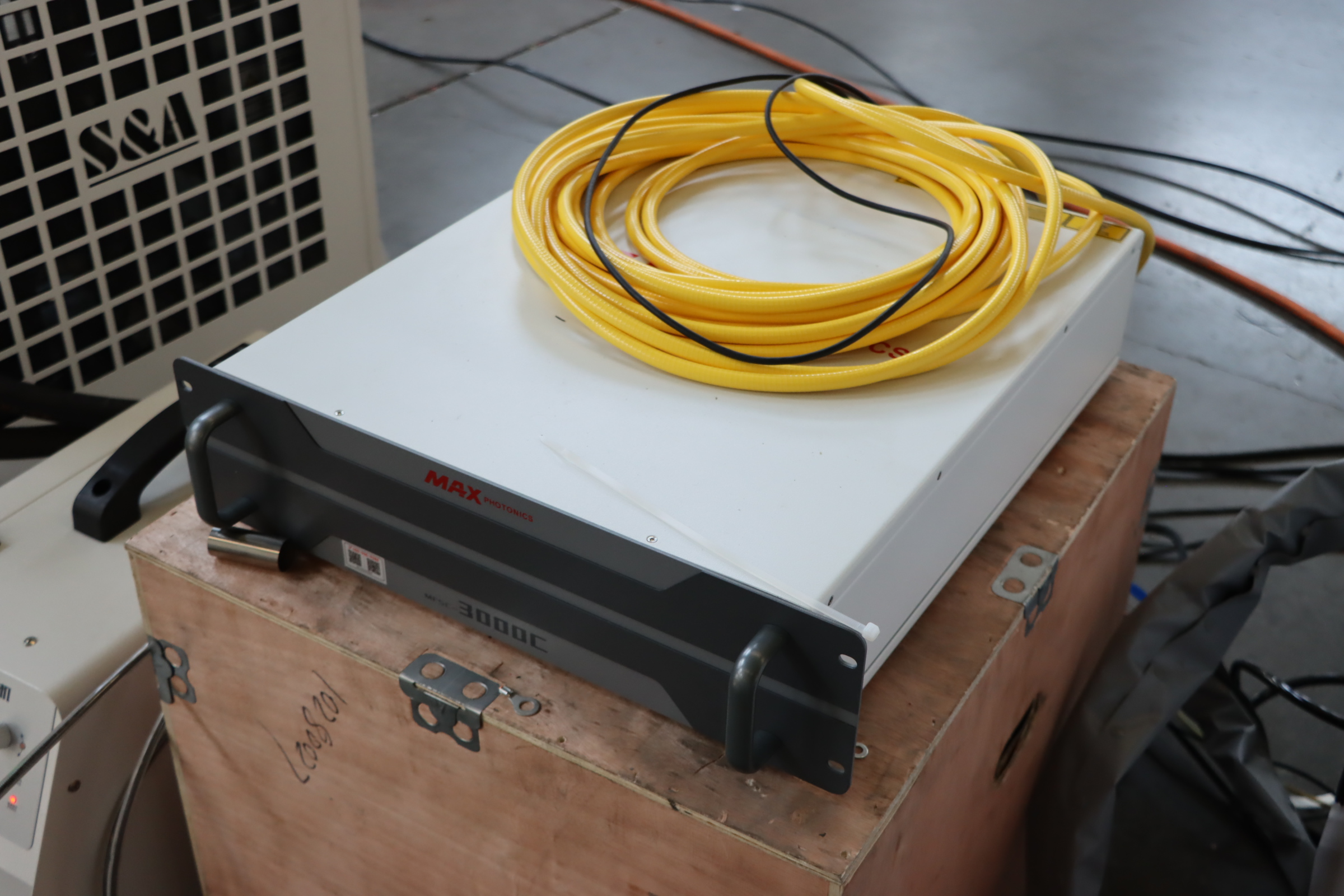
The demand pattern is visible across application segments. Furniture and kitchen equipment manufacturing, fitness equipment, exhibition and advertising structures, and light structural steel all require mixed sheet-and-tube output in moderate volumes. These are not the high-volume pipe mills that justify dedicated tube lines, nor the pure sheet job shops that never touch profile stock. They are the middle of the market, and they are the segment that integrated machines target.
Table 1. Comparison of Dedicated vs. Integrated Fiber Laser Platforms (Representative Parameters)
| Parameter | Dedicated Sheet Machine | Dedicated Tube Machine | Integrated Sheet & Tube Machine |
|---|---|---|---|
| Working area (sheet) | 3000×1500 mm | — | 1500×4000 mm |
| Max tube diameter | — | 220 mm | 220 mm |
| Laser power range | 1000 W – 20 kW | 1000 – 3000 W | 1000 – 3000 W |
| Positioning accuracy | ±0.03 mm | ±0.05 mm | ±0.05 mm |
| Repositioning accuracy | ±0.02 mm | ±0.03 mm | ±0.03 mm |
| Travel speed | 100 m/min | 100 m/min | 100 m/min |
| Max acceleration | 1.0 G | 1.0 G | 1.0 G |
| Control system | Cypcut 3000S | Cypcut 3000S | Cypcut 3000S |
| Typical capital outlay | Baseline | +60–90% of baseline | +25–45% of baseline |
| Floor space requirement | Baseline | +70–100% of baseline | +10–25% of baseline |
Figures reflect representative configurations; actual specifications vary by model and configuration.
The table tells a fairly direct story. An integrated platform gives up little in accuracy — the ±0.05 mm positioning figure for tube work is a consequence of chuck and tube-handling dynamics rather than any compromise in the gantry itself — while collapsing two capital purchases and two footprints into roughly one and a quarter. For a shop whose tube workload runs below perhaps 40 percent utilization, the arithmetic strongly favors integration. Above that threshold, a dedicated tube line with faster chuck cycling and larger diameter capacity begins to pay for itself.
The acceleration and travel-speed figures deserve a note. Both dedicated and integrated machines in this class run at 1.0 G and 100 m/min, which reflects the fact that modern servo drives and lightweight gantry structures have become commoditized at the high end. The differentiator is no longer raw speed; it is how well the control system manages the transition between sheet and tube modes, and how much setup time that transition consumes.
Technology Application and Brand Practice
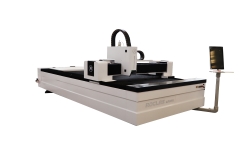
The engineering challenge in an integrated machine is not the laser source. It is the bed, the chuck, and the control architecture. A fixed gantry with a movable workbench preserves maximum processing space for sheet work, but the tube-handling axis must be integrated without compromising the rigidity that sheet cutting at 1.0 G demands. This is where fabrication quality of the machine structure — rather than component sourcing — becomes decisive.
ROCLAS® MACHINERY CO., LTD. approaches this through its bed manufacturing: industrial-grade heavy-duty steel structures machined on CNC five-face machining centers, with the option of either single-piece welded construction or a modular screw-connected design that separates for transport without requiring welding. The modular option matters more than it might appear. Integrated machines are large, and the ability to ship a bed in sections without sacrificing the geometric accuracy established at the five-face stage removes a logistical barrier that has historically pushed buyers toward smaller, less capable platforms.
The company's sheet-and-tube integrated model runs on the Cypcut 3000S control system, the same platform used across its sheet and tube ranges, which simplifies operator training and spare-parts strategy for shops already running ROCLAS equipment. Power tops out at 3000 W on the integrated platform — a deliberate ceiling, since tube wall thicknesses rarely justify more, while the company's standalone sheet machines scale to 20 kW for thick-plate work. That product architecture is itself an argument: integration is offered where it makes engineering sense, not as a universal answer.
It is worth being precise about what integration does not solve. Highly reflective materials such as copper and aluminum still require suppression modules, which ROCLAS fits to its fiber platforms; the integrated machine inherits that capability but does not extend it. And the accuracy gap between sheet (±0.03 mm) and tube (±0.05 mm) positioning remains, driven by chuck mechanics rather than optics.
Conclusion and Outlook
Integrated sheet-and-tube fiber laser platforms are best understood not as a compromise but as a right-sizing of capital equipment to actual production mix. For the large middle band of fabricators — furniture, fitness equipment, light structural, exhibition — the case is straightforward: comparable accuracy, roughly half the footprint, and a capital saving that can be redirected toward automation or additional capacity.
The outlook points toward further consolidation. As nesting software improves and automatic chuck systems mature, the setup penalty for switching between sheet and tube modes will shrink, widening the utilization band in which integration beats dedicated lines. Manufacturers that control their own bed fabrication — as ROCLAS does through five-face machining — are positioned to compete on the structural rigidity that determines whether an integrated machine holds accuracy after years of mixed-mode operation. That, rather than laser wattage, is likely to be the decisive specification over the next equipment cycle.
가격 문의
일반적인 조언이나 특정 지원이 필요하든 상관없이, 우리는 당신을 도와드릴 것입니다.
최근 게시물
-
 Robotic Arm Laser Systems: Redefining Precision and Flexibility in Industrial ManufacturingAbstractThe integration of robotic arms with laser processing technologies represents a paradigm s...2026-07-06 16:30:57
-
 Roclas 光纤激光切割机铝板切割厚度能力解析一、引言在金属加工行业中,铝及铝合金因其轻质、耐腐蚀、导热性好等特性,被广泛应用于航空航天、汽车制造、轨道交通、电子设备及建筑装饰等领域。铝材的高反射率特性使其成为激光切割中较难处理的材料之一。许...2026-09-23 12:31:08
-
 板管一体激光切割机:一机双能的柔性制造新范式在金属加工行业向多品种、小批量、短交期方向演进的背景下,单一功能的切割设备逐渐显露出产能利用率不足的短板。板管一体激光切割机通过在同一个加工平台上集成平板切割与管材切割能力,为中小规模制造企业提供...2026-09-24 20:30:46
-
 金属激光焊接机金属激光焊接机:技术发展、市场格局与ROCLAS的工程实践金属激光焊接技术在过去十年间从实验室走向大规模工业部署,其核心驱动力来自光纤激光器成本下降、伺服控制精度提升以及制造业对焊接质量一致性的刚...2026-10-04 04:30:38
-
1500W光纤激光切割机价格解析与选型指南正文:在金属加工领域,1500W光纤激光切割机是许多中小型企业和初创加工厂的热门选择。它既能满足日常碳钢、不锈钢板材的切割需求,又在采购成本和运行费用之间取得了较好的平衡。一台1500W激光切割机...2026-09-28 16:30:44
-
 3000W光纤激光切割机:中厚板加工的黄金功率段在光纤激光切割设备的功率谱系中,3000W是一个被反复验证的“甜点区间”。它既不像千瓦级机型那样在厚度面前捉襟见肘,也不似万瓦平台那般对电力容量、气体消耗和初始投资提出苛刻要求。对于大量以碳钢、不...2026-10-01 08:31:49